

feature

myvalleysun.com
October 17, 2013
Bullish on the real news in the Monashee
My Valley Sun
blog
index

Online Community News for Lumby, Cherryville, Rural Coldstream and Highway 6
We update this website on a regular basis. We are eager to receive your news, events, advertising and letters by email at: mediaservices@uniserve.com

MyValleySun.com is community-based media and we help to improve the quality of life in the communities we serve by providing meaningful online news programming that informs, involves and inspires.
Support Local News
Subscribe - Advertise
Contribute - Purchase
Help us make more stories like this happen...
A store that supports
community-based media
Visit the BullMarket and
support MyValleySun.com
 | ||||

In recent years, honeybee populations have rapidly declined, in part due to a phenomenon known as Colony Collapse Disorder. Bumblebee populations have been suffering as well, according to Dave Goulson of the University of Stirling in Stirling, U.K., who is a co-author of one of the studies.
"Some bumblebee species have declined hugely. For example in North America, several bumblebee species which used to be common have more or less disappeared from the entire continent," he said. "In the U.K., three species have gone extinct."
Researchers have proposed multiple causes for these declines, including pesticides, but it's been unclear exactly how pesticides are inflicting their damage.
"It's been difficult to make direct connections between pesticides as they would be encountered in natural conditions, and the negative impacts we've seen in laboratory studies," said Science Associate Editor Sasha Vignieri at a Paris press conference about the papers hosted on March 29th.
Both of the Science studies looked at the effects of neonicotinoid insecticides, which were introduced in the early 1990s and have now become one of the most widely used crop pesticides in the world. These compounds act on the insect's central nervous system, and they spread to the nectar and pollen of flowering crops.
In one study, Penelope Whitehorn of the University of Stirling in Stirling, U.K. and colleagues exposed developing colonies of bumblebees, Bombus terrestris, to low levels of a neonicotinoid called imidacloprid, found in brand name pesticides such as Gaucho, Prestige, Admire, and Marathon. The doses were comparable to what the bees are often exposed to in the wild.
The researchers then placed the colonies in an enclosed field site where the bees could forage under natural conditions for six weeks. "These bees perform extraordinary feats of navigation in the real world" to find and bring food back to their colonies, Goulson said at the press conference. "Anything that reduced its ability to learn or to navigate could have a very big effect in the wild which would not be detected or detected very weakly in a lab situation."
At the beginning and end of the experiment, the researchers weighed each of the bumblebee nests -- which included the bees, wax, honey, bee grubs, and pollen -- to determine how much the colony had grown.
Compared to control colonies that had not been exposed to imidacloprid, the treated colonies gained less weight, suggesting less food was coming in. The treated colonies were on average 8% to 12% smaller than the control colonies at the end of the experiment. The treated colonies also produced about 85% fewer queens. This last finding is particularly important because queen production translates directly to the establishment of new nests following the winter die-off. Thus, 85% fewer queens could mean 85% fewer nests in the coming year.
"Bumblebees pollinate many of our crops and wild flowers," Goulson said. "The use of neonicotinoid pesticides on flowering crops clearly poses a threat to their health, and urgently needs to be re-evaluated."
In the other Science report, a French team found that exposure to another neonicotinoid pesticide impairs honeybees' homing abilities, causing many of the bees to die.
Mickaël Henry of the French National Institute for Agricultural Research (INRA) in Avignon, France, and colleagues tagged free-ranging honeybees with tiny radio-frequency identification or "RFID" microchips that were glued to each bee's thorax.
These devices allowed the researchers to track the bees as they came and went from their hives. The researchers then gave some of the bees a sub-lethal dose of the pesticide thiamethoxam, which has been sold under the brand names Cruiser and Platinum.
Compared to controlled bees that were not exposed to the pesticide, the treated bees were about two to three times more likely to die while away from their nests. These deaths probably occurred because the pesticide interfered with the bees' homing systems, the researchers propose.
In the second part of their study, the researchers used data from the tracking experiment to develop a mathematical model that simulated honeybee population dynamics. When the mortality caused by the homing failure was incorporated into the simulations, the model predicted that honeybee populations exposed to this pesticide should drop to a point from which it would be difficult to recover.
At the press conference, Henry said this simulation showed the bee populations could suffer "a marked decline in a matter of weeks," leaving them more susceptible to other stresses such as parasites and climate change.
The authors note that even though manufacturers are required to ensure their pesticide doses remain below lethal levels for honeybees, the studies used to determine this lethality level have probably underestimated the ways that pesticides can kill bees indirectly, for example by interfering with their homing systems.
"Our study raises important issues regarding pesticide authorization procedures," said Henry. "So far, they mostly require manufacturers to ensure that doses encountered on the field do not kill bees, but they basically ignore the consequences of doses that do not kill them but may cause behavioral difficulties."
This story was written as a result of materials provided by American Association for the Advancement of Science.
(30)
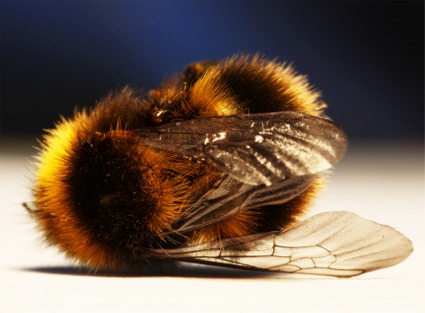
BEES
This past week the American Association for the Advancement of Science reported in the journal Science, that in two separate studies, scientific teams in both the U.K. and France have found that a widely used insecticide can threaten the health of bumblebee colonies and can interfere with the homing abilities of honeybees.
March 30, 2012
DEAD
A new discovery about how bees are harmed by common crop pesticides...
Bumblebees and honeybees are important pollinators of flowering plants, including many major fruit and vegetable crops. Each year, for example, honeybee hives are driven from field to field to help pollinate almond, apple, and blueberry crops, among others.
more about bees at MVS....
robotic pollination
If you’re concerned about pesticides or genetically engineered foods, then you will find this story quite disturbing.
In fact it will really bug you.
