
Factory Village
concept

2012 - Celebrating Exploration & Discovery in the Monashee
How well do you know our local history?


ideas

October 17, 2013
Bullish on the real news in the Monashee
My Valley Sun
blog
index

Online Community News for Lumby, Cherryville, Rural Coldstream and Highway 6
We update this website on a regular basis. We are eager to receive your news, events, advertising and letters by email at: mediaservices@uniserve.com
The Lumby
Live, Work & Play
A Made in the Okanagan solution for industrial development that meets the demands of small manufacturers in the new greener economy.
Prepared by Don Elzer
This proposal was generated as a direct alternative to building a provincial prison in Lumby. The factory village is an attempt to move forward on the existing features that residents wish to pursue that would enhance the quality of life in this community and develop a stable tax base.
I first proposed the factory village in 1995 as an adjunct to downtown revitalization planning which was happening as a result of sawmill closures. I had forecast that there would be a growing need for small industrial lots from small scale family-owned manufacturers. Lumby needed to address the clean-up of industrial lands and in particular the possibility of high levels of dioxins caused by wood waste.
The community also had to address the changing industrial landscape and the emergence of free trade and globalization. At the time transportation links such as the future of the railway were being placed in question and it appeared as though it would be extremely unlikely that large industrial tenants would ever return.
While the business community saw great potential in the proposal the regional economic development authorities including Community Futures ignored the concept and left it out of key planning documents as did Lumby Village Council. Without this support the concept went into mothballs.
Fifteen years later, the industrial landscape remains unchanged in Lumby, however it has now been proven that there is a market appetite for small industrial lots and there is a need to tackle land cleanup. Lumby continues to be well positioned to emerge as a leader in the new localization movement and the 100 mile economy.
- Don Elzer
 the Lumby Live, Work & Play Factory Village proposes that large portions of industrial land in Lumby would be subdivided into smaller lots consisting of a mix of residential lots and industrial lots. The industrial lots would be created to contain buildings that would each include a factory retail outlet and living space if required.
As a
As a
concept,
concept,
A Live, Work & Play Factory Village is an efficient solution for the redevelopment of industrial lands for BC rural communities.
The Village of Lumby is rich in industrial property, however much of the land is currently within large parcels left over from the days when large sawmills supported the tax base. Much of this land was home to heavy industry for a century and requires significant clean up. Current property owners are challenged with high cleanup costs particularly since much of this land is within a flood plain where drainage areas feed riparian zones along salmon bearing creeks.
The Live, Work & Play Factory Village seeks to reinvent the way a small community can build an economy linked to manufacturing so that public private partnerships can occur to address the obstacles of cleanup, design, investment and the marketing of such industrial property.
The Factory Village also meets with meeting emerging demands for industrial property by small scale manufactures in their quest for smaller footprint production facilities that are affordable.
CONCEPT
Rationale
As a concept, the Lumby Live, Work & Play Factory Village proposes that large portions of industrial land in Lumby would be subdivided into smaller lots consisting of a mix of residential lots and industrial lots. The industrial lots would be created to contain buildings that would each include a factory outlet and living space if required.
The development would provide significantly more tax revenue for the village and would require that the developer supply service infrastructure to the lots – these costs would be recovered through the sale of lots and within a build-to-suite model of development.
The development would provide a means by which old industrial lands could be cleaned up and creek riparian areas could be restored and expanded. The development also provides a means by which affordable housing could be created and this along with the added factory residents and workforce would add to the population and local economy in the village and surrounding area.
Design Concept
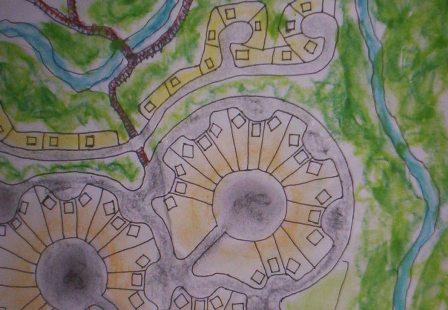
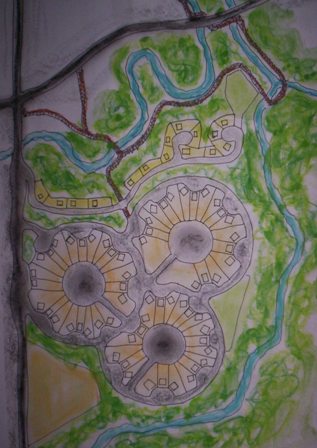
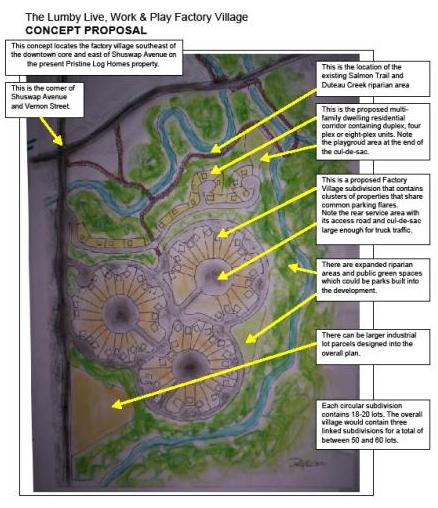
The concept considers the development of 60 industrial lots within a pre-designed factory outlet formula where each stand-alone building is clustered with two or three others. Each of them would have a front entrance showcase/retail area where the producer would be able to sell from. The cluster would share a common flared customer parking area and would be aesthetically linked together with a landscaped walkway which would then link to the next factory outlet cluster. When combined these walkways would create a linear park system that would link to the downtown and the salmon trails.
Each factory outlet building would be capable of containing a second floor or loft residence for the producer and his/her family. These residences would have a side entrance that opened to the linear landscaped area which would be separated from the back industrial work area.
The layout of the overall development would contain a number of these factory outlet clusters each linked within a circular design and accessed by a service road ending with a cul-de-sac where each industrial property would be serviced from. Properties would appear to be laid out in spokes with the cul-de-sac in the center. This layout would create a natural buffer for industrial activities and would direct truck and equipment traffic away from customer service areas.
Each of these circular subdivisions would contain about twenty properties which could vary in size, in fact, for factory owners not requiring land; they could exercise an option and could lease their land space to a neighbor etc. Within the Lumby design model there would be three of these subdivisions that would be linked together by both roads and walkways, further creating a circular design that would slow traffic and create visual buffers.
The Riparian Areas
With the development of the factory village there would be an opportunity to grow creekside riparian areas by incorporating salmon spawning restoration into the development design. By including a linear walkway throughout the village that was in keeping with riparian designs a greatly expanded buffer zone could be established between industrial activity and natural eco-systems. This additional green space would help to retain moisture required for the creekside aquifers; and by expanding the forest canopy, creeks and surface drainage would be kept cooler in the summer months which would be valuable for encouraging a healthy salmon fry environment.
By adding a residential zone between creek areas and the factory village there is a further softening of human activity which aids to healing this longtime industrial area and moving it closer to a carefully managed wetlands area.
The Residential Zone
Between the Factory Village and the creekside areas there would be a single thread of 15-30 residential lots that would contain multi-family dwellings. This subdivision would be designed to end in a cul-de-sac in order to maintain local traffic only and would be protected from the factory village by a series of green spaces and treed shelterbelts but would be joined through a series of walkways that would link to the industrial area, the Salmon Trails and the downtown area.
The residential zone brings more family residents to the immediate downtown area and potentially provides a close workforce to the industrial area as well.
Artistic Rendering
The artistic rendering within this concept proposal is for discussion purposes. The renderings are based on a contemporary version of a northwest native longhouse design and painted with Interior Salish style pictographic designs. Each building has a unique house pole carved as a contemporary form to help accent the front façade. This colorful design adds to the further uniqueness of each building in the village as a visitor attraction.
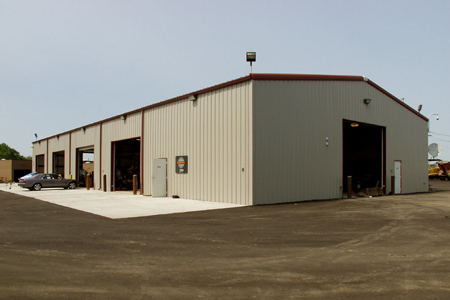
The buildings themselves are derived by utilizing a steel building and then adding a glass atrium as the factory outlet entrance area. A steel building allows for an inexpensive structure that meets with industrial safety protocols and requires low maintenance.
The buildings are high enough to provide a second story for living quarters or office space. Buildings could be any size and could be constructed by the developer to suit the needs of the purchaser.
Because of this simple design it becomes more cost effective to add “green” technology into the buildings because applications can be designed to meet with a “one size fits all” installation formula.
The Market
The Factory Village has a distinctive audience as it would appeal to the small manufacturer or supplier who requires indoor space of approximately 4000 square feet or more and outdoor space of between a half and two acres. This market often consists of artisan type manufacturers who may be doing a small or medium scale packaging or processing operation.
Other businesses may be assembling products for re-shipping, this requires space for storage. All of these sorts of businesses would consider space for future growth, many consider the importance of having direct sales opportunities and all of them require competitive land prices and taxes etc. Some of the future factory village residents might be found in Kelowna, Kamloops, and the Lower Mainland where industrial property is hard to find and very costly. Many existing small factories wanting to expand may look at Lumby as a viable place to relocate.
Key to the marketplace is the need for some factory residents to locate where quality of life factors are high and where there is a deliberate community economic development strategy to attract not only a certain kind of industry, but an entire value-chain that supports that industry.
What is a Value-Chain?
A value chain is a chain of activities operating in a specific industry. Products pass through all activities contained in the chain, and at each activity the product gains some value. The chain of activities gives more value to the product and because all the links within the chain are close at hand such value is delivered at peak efficiencies.
The Residential Market
The residential component of the development would seek to attract families. The development would contain affordable housing within duplex, four plex and eight plex units. With large lot sizes, treed walkways and a large park/playground area at the end of the development would be very inviting if designed to be attractive in keeping with “green” modes of construction.
Establishing a Location
The factory village remains a concept that requires buy-in from a present property owner in the Lumby industrial area. For the purposes of rolling out the idea - the concept plan has been designed for the Pristine Log Homes property which is also the former Fletcher Challenge/Crown Zellerbach property. However, the concept could be applied to any larger industrial property or group of properties.
Development Approach
Key for delivering the Factory Village concept would be an integrated partnership agreement that included the property owner who may also serve as the developer, the village, and both the provincial and federal governments. Each plays a distinctive role, and while there are many development models that could be proposed the following represents a sketch of what each partner may provide the project.
The Property Owner/Developer
Would be providing the land and then the investment into the design, infrastructure, subdivision and then managing the sale and construction of the Factory Village. They would be bringing services to each lot and they would be receiving a financial return based on the sale of lots, profits from construction based on a “build to suite” formula but based on a strict design code and perhaps an ongoing management fee for maintaining the overall development similar to a strata manager.
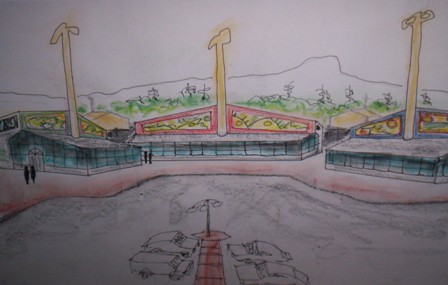

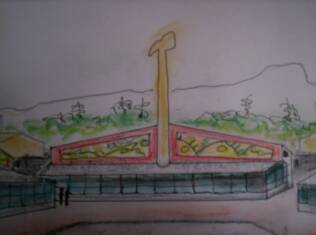
Concept of a typical three building cluster with a common contemporary front design in the factory village with a shared parking area.
Concept design of a typical factory village building with glass atrium storefront.
Conventional steel buildings are used as the structure to support unique design themes at an affordable cost
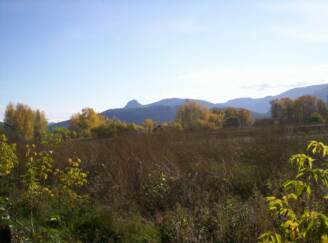
The proposed industrial site in Lumby.
Village of Lumby
Would need to develop an adequate concept strategy that would include incentives that the village could provide the project. It would then negotiate with industrial property owners in order to convince one or more of them to develop their land into the Factory Village. The following represents possible incentives that the Village could provide the property owner/developer:
- Planning, zoning and engineering support that removes barriers in accordance to the concept plan.
- Procurement support for accessing government programs and investment capital for the project including environmental cleanup and riparian restoration as well as public areas such as walkways and parks.
- Venture capital for the project, perhaps in the form of a debenture offering or community bond dedicated to the purchase of some of the Factory Village properties which in turn could be leased out or applied to special community-driven projects. The purchase of these properties could serve to anchor activity for the start of the development.
- Marketing assistance and tools that could attract investment into the development and aid in the sale of properties.
- An industrial tax incentive, perhaps a one year tax holiday for purchasers of properties, or to the developer while the development is in the planning and development stage.
Provincial Government
A special effort to deliver funds and loans that would assist in the development of the project as well as clean-up costs and riparian restoration.
Funding assistance for the development of infrastructure, planning and engineering for the project.
Funding support and incentives for energy efficient and green construction solutions.
Support for attracting businesses into the Factory Village.
Federal Government
Dedicated assistance and financial support for accessing government programs and investment capital for the project including environmental cleanup and riparian restoration as well as for public areas such as walkways and parks.
Funding support and incentives for energy efficient and green construction solutions.
Support for attracting businesses into the Factory Village.
As special grant/loans fund managed by Community Futures that would support businesses willing to locate in the development.
Other supporters
The local bank and credit union could create a special loan bundle for supporting property purchasers.
Marketing Approach
Lumby should be attracting businesses which are part of industry value chains. This region has a very diversified economy, already there is an opportunity to attract businesses that support wood, energy, food, creative and agriculture industry value chains. Opportunities could exist by promoting the village into the following markets:
- A place for regional factories to expand where industrial property is scarce and values are unaffordable such as in the Lower Mainland, Kelowna and Kamloops.
- There is already a Forest Products Value Chain which could be expanded.
- An Agriculture Value Chain could cluster artisan food processors which could utilize farm products from the area. These producers like to be located where farmers are still in the business of farming which is the case in this part of the Okanagan.
- Brookfield Power (Wind Turbines) who currently are securing land in the region for wind generation and would require storage, maintenance and assembly space. They could anchor an alternative energy factory village.
- Lumby currently has an auto-recycler which provides a rich opportunity to attract businesses that require decommissioned automobiles as a resource. Transmission and engine rebuilders would represent additions to an auto recycling value chain. Lumby could promote a transportation factory village that supports extending the life of an average automobile by 20 years.
The Ripple Effect
There is a significant ripple effect that the Live, Work & Play Factory Village can offer Lumby and the North Okanagan. The village itself would receive significantly more tax revenue than it presently experiences and by rebuilding its manufacturing base it improves the economic culture of the community. Small manufacturers which are also providing retail outlets will involve themselves with the community as consumers and supporters of clubs and organizations.
The factory outlet becomes a tourist destination and because there are many within the factory village the dwell time for visitors would be significant.
As each producer promotes their product, they promote the community. This marketing presence would be invaluable to the community - and as producers grow into export markets not only will international revenues be added to the local economy, but international exposure would be ongoing.
Key to the ripple effect, would be the establishment of a factory village as a tangible offering into a marketplace that links to the new and emerging green economy. This becomes something that the village could promote and “sell” as a means to grow and add value to its tax base.
Becoming a “Living” Transition Town
An essential aspect of transition in many places like Lumby, is that the outer work of transition needs to be matched by inner transition. That is in order to shift a local “old world” economy into a new “green economy” effectively - we need to rebuild our relations with ourselves, with each other and with the "natural" worlds. That requires focusing on the heart and soul of transition.
Transition Towns (also known as Transition network or Transition Movement) is a brand for environmental and social movements “founded (in part) upon the principles of permaculture. The Transition Towns movement is an example of socioeconomic localization.
The main aim of this effort generally, and echoed by the towns locally, is to raise awareness of sustainable living and build local ecological resilience in the near future. Communities are encouraged to seek out methods for reducing energy usage as well as reducing their reliance on long and distant supply chains that are totally dependent on fossil fuels for essential items. Food is a key area, and they often talk of "Food feet, not food miles!" Initiatives so far have included creating community gardens to grow food; business waste exchanges, which seeks to match the waste of one industry with another industry that uses this waste; and even simply repairing old items rather than throwing them away.
By focusing on creating a factory village we are moving Lumby further into a living transition that can begin to create a leading edge approach to economic development and serve as a model to other communities which will help our planet.
Something to be proud of and good work for sure!
Send us feedback on this idea - write us a letter.
A sample Factory Village site plan that could be a concept applied to any large industrial parcel in Lumby providing property owners were interested.
