

2012 - Celebrating Exploration & Discovery in the Monashee
How well do you know our local history?

feature

October 17, 2013
Bullish on the real news in the Monashee
My Valley Sun
blog
index

Online Community News for Lumby, Cherryville, Rural Coldstream and Highway 6
We update this website on a regular basis. We are eager to receive your news, events, advertising and letters by email at: mediaservices@uniserve.com
The strange road
to discovery….
By Don Elzer
This past spring
the old roof, on my very old print shop which houses my relatively ancient printing equipment failed. This caused a refreshing Spring downpour to become a key element of change for a building what had become a storage area and one that I had largely avoided because of the nature of the storage.
Thirty years of paper.
Publishers keep copies of everything they published, the longer they publish the more paper there is and paper and downpours generally don’t go well together – particularly if the downpour is inside of a building.
I had been content on letting nature take its course, choosing to allow the summer to dry out everything. So come August I watched several episodes of Indiana Jones in order to examine closely just how he navigated through dark and hideous places in order to rescue antiquities.
I had wondered if there would be snakes.
Nevertheless I made my way into the old building and began carting out many boxes of archives, pillaging walls and bringing about the destruction of areas no longer worth saving.
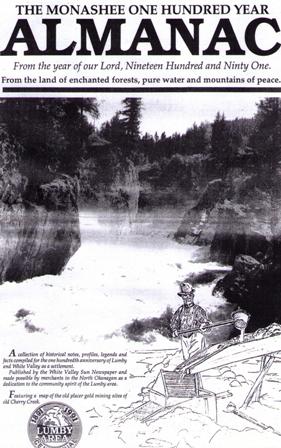
To my surprise, deep into the dark abyss I found several bundles of the Monashee 100 Year Almanac which I had published 1991 to celebrate Lumby’s 100 year centennial of incorporation. I opened a copy and began to browse until I sunk into a deep reminiscent read.
People who know me understand how I become easily distracted by events such as this. It will be the reason why the clean up of the printshop will take a decade – not because it’s a big job, but because there’s so much to read along the way.
My diversion mixed with some minor arithmetic caused me to discover that the years 1862 and 1863 translate into important dates beginning in 2012.
2012 marks 150 years of gold exploration and discovery in the Monashee. This gives Cherryville a great opportunity to define itself as one of the oldest, if not the oldest community in the Okanagan. While we may never know the exact date and time when gold was first discovered glittering in the sandbar, we know that in 1862 the first whispers of gold being discovered at Cherry Creek had reached the provincial government, and that the discovery was important enough, that by 1863 the province which was then a provincial colony and not yet part of Canada, had commissioned bridge and road contracts to better manage the influx of activity which included 200 miners who had begun working placer claims.
2012 also marks the 100th anniversary of the BC Forest Service and the 50th anniversary of Monashee Provincial Park.
So I have set out to produce another Almanac. The Monashee 150 Year Almanac will be a commemorative print publication that follows in the footsteps of the Monashee 100 Year Almanac, published 20 years ago.
It’s my hope that we as a collection of communities in the Monashee can explore our past, and tell our stories. 2012 provides an opportunity to create a vision for the next 150 years by celebrating our accomplishments, recognizing our failures and capturing our dreams for the future.
Bring to life our regions history, explore it’s mysteries and riddles and discover the storyteller within.
Advertise in the 2012
Monashee 150 Year Almanac
Please join us so that we can compile and produce this commemorative publication that’s a keeper, one that celebrates some of the lesser known stories about this great region that bridges the Okanagan with the Kootenay and represents one of BC’s great adventure playgrounds.
Contact us at the Discovery Centre
250-547-9812
Download an advertising rate sheet.
The Monashee 100 Year Almanac published in 1991 to celebrate Lumby’s 100 year centennial of incorporation.

imag ne...
Re-creating Community
i
Perhaps it's time for Area D to embark on its own path by creating a rural municipality.
But what might this look like?
By Don Elzer
Foothills
A Countryside Formerly Known as Lumby
It’s this kind of logic that brings out the very worst in all of us, and it appears that arguing with this twisted logic simply adds fuel to the fiery split that has remained constant in the wider community.
And we can’t forget why it happened in the first place.
Some people want Lumby to be home to a jail, and others don’t.
Presently, community leaders have handed the final decision to the provincial government, which for some residents is considered a form of treason – and this adds further fuel to the argument that community autonomy is at risk. Some of us believe that community is defined by a landscape shared by neighbors and not one that is defined by a tax role.
So perhaps its time to go – to leave – to escape from what is appearing to be a dynamic of irreconcilable differences?
But what if some of us or perhaps all of us, have committed to our families, relationships. homes, our land, and our community as being non-perishables? What if our souls are linked so closely with this place that we cannot leave – what if “we” are now the land, or the place?
Perhaps what we are witnessing are the seeds that grow within a community where its’ people will fight to retain and protect it – at any cost? In some parts of the world small populations of people arm themselves to demonstrate sovereignty and this often escalates into violence which can often last for generations.
Collectively, we can’t let things deteriorate to the point where such polarization turns into violence, whether it’s a form of verbal abuse or more physical. We have to renew our sense of community and examine very closely how we arrived at these fatal divisions in the first place.
Today, the division that ranks most prominent is between residents in the Village of Lumby and residents in Area D. If this division continues to widen, perhaps its time for Area D to consider its own self-determination by forming a rural township or municipality – one without the Village.
Call this a simplistic exercise in possibilities. One that may, or may not be possible. Imagine with me, Area D as a rural township called Monashee Foothills.
The Monashee Foothills Rural Township has a population of approximately 3000 people which is nearly double the size of the Village of Lumby. To the west it borders the District of Coldstream, the North Okanagan Regional District and Silver Star Provincial Park; to the south it borders Lake Country and the Central Okanagan Regional District; to the east it borders Area E in Cherryville. It can be defined as the Middle Shuswap.
Monashee Foothills surrounds the Village of Lumby much the same way as the Rural Township of Spallumcheen surrounds the City of Armstrong. Similar to Spallumcheen, Monashee Foothills endeavors to retain its rural and agriculture presence by fighting off urban encroachment into farm areas.
The township does have a major industrial tax base. At the western entrance of Monashee Foothills, visitors are greeted with a highway pullout and kiosk that describes the entrance of the township as a place where the Columbia and Fraser watersheds meet. This particular spot on Highway 6 is also home to a large industrial area with a rail link that includes Tolko’s White Valley Sawmill, Willem’s Forest Products, a community run log sort yard and a Factory Village made up of small cottage scale manufactures. From here, Whitevale Road meanders to the hamlet of Whitevale a residential area within the township where the Monashee Foothills municipal office, public works yard and community hall are located. This civic service cluster also contains Whitevale Community Elementary School and a hockey arena which is also home to a year round hockey school.
On the eastern edge of Whitevale is a second industrial area with a commercial corridor just south of the Village of Lumby, a collection of other industrial areas are sprinkled throughout the township and they demonstrate the historical link the community has had to innovation, cottage industry and value-added wood and food processing.
Monashee Foothills is represented by a Mayor and four councilors who are supported by a series of local watershed commissions or districts. The Middle Shuswap/Mabel Lake, East Silver Star, Park Mountain, Creighton Valley and Blue Springs watershed commissions are made up of volunteer residents who are tasked with overseeing water, land and development issues that impact their local watershed areas, and they report to the local township council.
These local watershed districts each have clusters of activities that define a sense of neighborhood, each has a local gathering hall and some have ecovillages which represent small footprint co-housing developments.
Monashee Foothills has within it a Community Forest which manages forests in sensitive ecosystems in conjunction with the local watershed districts. There is a small footprint resort corridor that links Mabel Lake Road with Silver Star. This corridor has within it a cottage development made up of small log homes which have been manufactured in the township. The cottages are linked together with cross-country ski trails making them attractive as ski-in ski-out homes.
Monashee Foothills is home to a number of wineries and commercial orchards which line south facing slopes. They present a statement about how the climate has warmed in recent years; the township is also home to a growing number of stevia plantations and takes pride in being a GMO Free Zone. The designation has attracted four large organic certified packing houses which have located within industrial areas and together employ 300 people.
Okanagan College located its Agriculture Trades and Technology Campus at the junction of Trinity Valley and Mabel Lake Roads. The campus specializes in non-chemical plant propagation and alternative energy technology within farm environments. The campus has a population of 400 students and has attached student housing and a business incubator. The entire campus is powered through the townships Community Energy Program.
Monashee Foothills Township has the most stable electrical rates in North America. The township owns the Wilsey Power Station at Shuswap Falls and a bioenergy power plant along with over 60 methane digesters located at a number of farms which all feed methane gas into the bioenergy plant. The energy produced by these two facilities have allowed the township to become energy self-sufficient. Low energy costs have also been used to attract key businesses to the area including the college campus which operates a 280,000 square foot greenhouse as a research facility which adjoins a year round public market.
Tourism attractions which include art studios, wineries and farms attract over 600,000 visitors annually, which provides enough support for two world class spa resorts in the township.
The township has retained its charm and its rural character. Small footprint developments are carefully tucked away off the beaten path as residents control local planning through their watershed commissions.
This vision of Monashee Foothills might be considered eco-topian by some, but for me I think it’s an achievable goal. It is becoming obvious that Area D is under siege. The Village of Lumby Council has performed a land grab to capture a Community Forest and the road to Silver Star, both of which are in Area D and both are being captured without permission – and without regard. In the process they have added further insult by saying that a prison in the village is none of our damn business.
I say, let’s not fight – let’s thoughtfully walk. Let’s take our population, our energy, our collective vision and build on the community efforts that we have been proud of. Decisions about how we govern ourselves should never be made in haste, we should be careful with our planning and actions and most importantly the entire community must be engaged within a decision making process. That being said, time creates history and it most certainly does not stand still. We need to address the issues that we have created for ourselves and face our fears. It was Albert Einstein who said, “The only reason for time is so that everything doesn’t happen at once.”
(30)
After 150 years of settlement,
perhaps its time for another change? Rural area residents living outside of the village have been told to take a hike. “This isn’t your town they say”. It seems that the idea of “community” in the eyes of some is simply defined by where you pay your taxes.
